
Dev log – Day 9
Summary
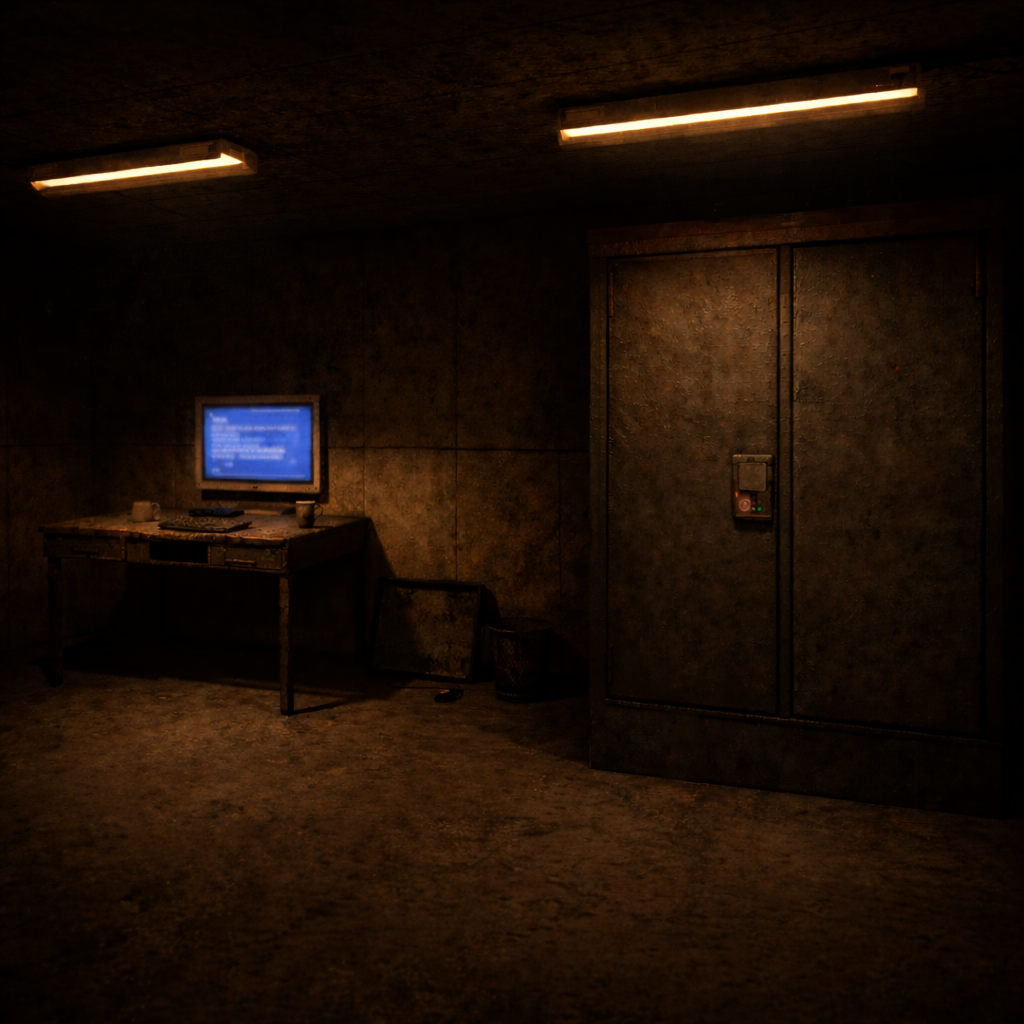
Today was all about pushing Room 1 closer to a finished, playable mood through a focused visual pass—upgrading the doors, desk, and locker presentation, switching the room over to a more flexible modular wall + door wall setup, and adding atmosphere via a flickering light effect and subtle dust. I also did targeted readability polish (monitor indicator glow) and validated that none of these visual upgrades caused interaction/collision issues or regressed the existing puzzle flow.
What I Worked on Today
Level 1 – Room 1 – Visual Pass (Doors, Desk, Locker, Lighting)
Intent
Upgrade Room 1’s core prop visuals and lighting so the space reads closer to a finished playable mood without changing gameplay. Replace placeholder presentation with more setting-appropriate meshes/materials and an atmospheric flicker pass.

What Actually Happened
Room 1’s key props were visually upgraded, starting with the doors and desk, followed by the locker while keeping Puzzle A fully functional. The room’s layout foundation was also improved by switching to a standardized modular wall/door wall approach and adding an instanced wall blueprint plus an additional wall size for flexibility. A flickering light effect was implemented and validated to be readable and non-intrusive, then small atmospheric polish was added via monitor indicator tuning and a subtle dust particle pass. Final checks confirmed the room reads cohesively and remains distinct from the test area.

Accomplished
- [STEP] Upgraded Room 1 doors with new meshes and materials to improve visual quality and establish the intended mood
- [STEP] Replaced Room 1 desk with an upgraded mesh and material set aligned with the room’s narrative function and visual tone
- [STEP] Switched Room 1 to a modular wall and door wall system using standardized 400u × 300u pieces to improve layout modularity and future iteration flexibility
- [STEP] Created BP_Wall blueprint using instanced static meshes to support efficient modular wall placement in Room 1
- [STEP] Added 100u × 300u modular wall section and created BP_Wall_100x300 to increase layout flexibility for Room 1
- [STEP] Upgraded the locker mesh and materials in Room 1 while preserving full Puzzle A interaction and functionality
- [TEST] Verified all upgraded Room 1 props maintain correct collision, interaction behavior, and do not regress existing puzzle functionality
- [STEP] Implemented a flickering light effect in Room 1 that is clearly visible, readable, and non-intrusive to gameplay interactions
- [TEST] Verified the Room 1 flickering light effect causes no interaction issues, visual confusion, or gameplay readability problems
- [STEP] Updated monitor red indicator light color and glow intensity to improve visual readability and overall look in Room 1
- [STEP] Added a subtle dust particle effect to Room 1 ceiling lights to enhance atmosphere and perceived depth
- [TEST] Verified Room 1 reads as a cohesive, visually consistent space and is clearly distinct from the test area


Technical Notes
- Modular wall approach standardized on 400u × 300u pieces, with extra coverage via 100u × 300u for tighter layout control.
- BP_Wall uses instanced static meshes for efficient modular placement and easier iteration.
- Lighting atmosphere pass included a flicker effect plus a subtle dust particle layer, validated for gameplay readability.
- Visual upgrades were regression-tested specifically for collision + interaction stability.

Challenges & Lessons Learned
- Visual upgrades can easily introduce gameplay regressions (collision, interaction traces, readability), so each prop/material swap needed validation in-context.
- Atmospheric lighting effects (flicker + dust) only work if they stay readable and don’t compete with interaction clarity—testing that early prevents wasted polish time.
Next Steps
- Continue refining Room 1’s visual identity with additional targeted polish passes (props/materials) while keeping interactions stable.
- Build on the modular wall system to support faster layout iteration without breaking the room’s cohesion.
- Add more small atmosphere/readability improvements where they reinforce the puzzle experience (without increasing clutter).
